 Back to docs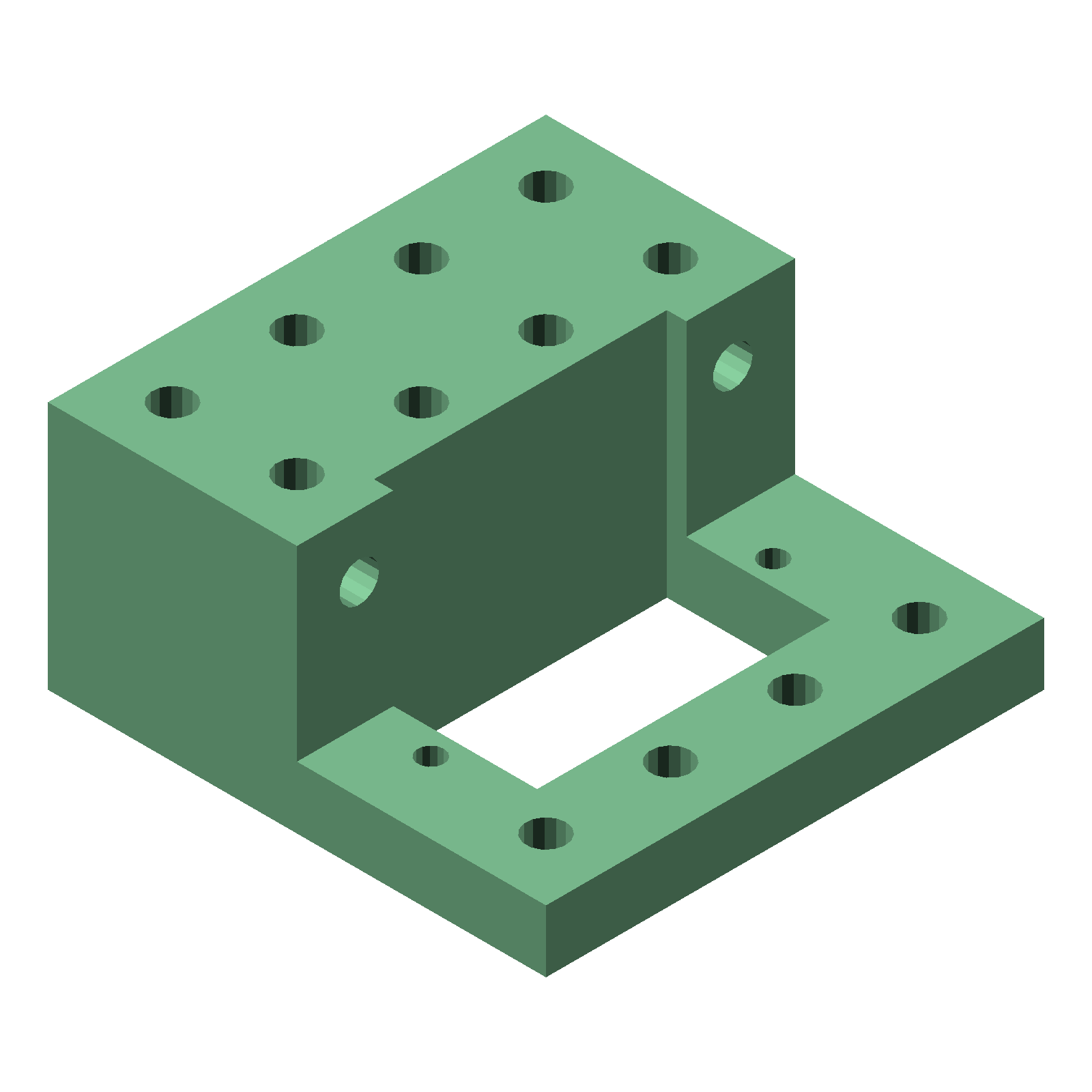
This is what is generated from mini_servo_down_bracket();.
Customizing mini_servo_down_bracket with OpenSCAD parameters
mini_servo_down_bracket is a grid plate with a cutout that holds a mini servo underneath, with holes for the servo's mounting screws and its output axle. Here it is called with every parameter spelled out:
| grid_columns | the plate size along X in 1 cm grid units (default 4). |
| grid_rows | the plate size along Y in 1 cm grid units (default 4). |
| plate_thickness | plate thickness in mm (default 5). |
| screw_spacing | the spacing between the servo's two mount holes in mm (default 27.5). |
| axle_position | the axle hole position relative to the servo box cutout in mm (default 8.25). |
| servo_box_width | the cutout width for the servo body in mm (default 12.11). |
| servo_box_length | the cutout length for the servo body in mm (default 22.53). |
| mount_hole_diameter | the diameter of the servo's mount holes in mm (default 2.1). |
| grid_hole_diameter | the standard grid hole diameter in mm (default global_default_hole_diameter). |
| axle_grid_column | the grid column the axle hole sits on (default 3). |
| axle_grid_row | the grid row the axle hole sits on (default 2). |
| echo_parameters | when true (default), the OpenSCAD console echoes the full parameter list when you preview or render the module. |
If you leave a parameter out of the module call, that parameter will just have the default value. For example, these are all valid module calls:
A down bracket is a general prpol motor bracket type: it points the motor's output shaft towards the surface the bracket is mounted onto. Because of that, it has to hold the motor some distance away from that surface. More motor bracket types are planned for future versions.